One API to rule them all
Stop chasing updates from Amazon, TikTok Shop, or Zalando.
Use MarketRock as an abstraction layer: a single, well-documented, stable, and scalable RESTful API to connect your ERP, CRM, or WMS to over 30 global sales channels.
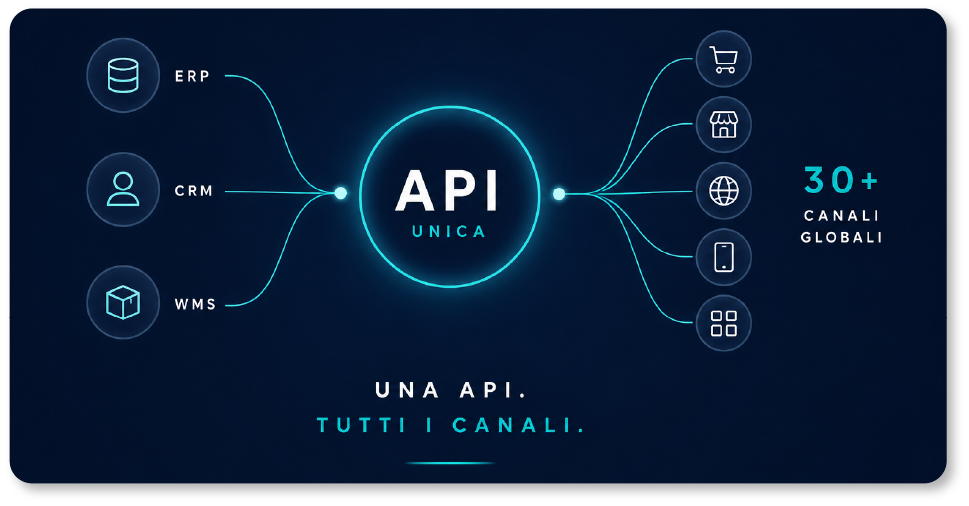
Marketplace Integration
Integration with marketplaces such as Amazon, TikTok Shop, or eBay is becoming increasingly important given their current commercial significance and the role they will play in the future. Typically, integration involves the exchange of data between an e-commerce site and marketplaces (for example, I want to list all the items I have on my site on Amazon) or between marketplaces and an ERP system (for example, I want to see Amazon orders come into my ERP system).
From a conceptual standpoint, integration is a simple process, but each case may present its own unique challenges depending on your starting point. Which e-commerce platform do you use? And which version? And what processes do you want to automate? Just the product listing part? And if so, in which countries? Do you also integrate logistics? And VAT services, such as those offered by Amazon?
Our recommendation is to take this process seriously, as it can be frustrating and time-consuming—if not costly due to a halt in online operations—if not properly coordinated. We’re sharing all the expertise gained by our “solution architects,” outlining the factors you need to consider, the key challenges, some case studies, and finally a checklist to review before activating the integration.
Preliminary Considerations
The first thing I’d like you to consider when thinking about integrating with marketplaces is what opportunities would justify taking this path. It may seem like an unpopular approach, but when working on elements that can be considered the “nervous system” of a company’s business operations, experience suggests caution.
Engaging in this common-sense reflection is a necessary step for both the customer and the supplier. From our direct experience, we can say that over the years we have essentially observed two different scenarios:
-
Professional sellers who handle large sales volumes. These are typically sellers who already have active marketplace accounts that generate at least hundreds of thousands of euros each year. Here, the mantra is “automate.”
-
Well-established companies with specialized teams. These are companies—often multinationals—that have no choice but to automate; they have the resources (both human and financial) to manage complex projects and a vision that is particularly goal-oriented. Here, the mantra is “we can’t do without it.”
So consider whether your situation falls into one of the two categories above before embarking on the path that will lead you to full integration.
Current Status of “As-Is” Processes
When we talk about integrations, we’re referring to the exchange of data between software programs. However, we must remember that this exchange of data is made possible by human activity: people are always at the center. When an integration becomes impossible to complete, it’s because people have failed, not the software.
When it comes to automating business processes—such as publishing a large number of articles on Amazon or TikTok Shop—the first and most important step is:
-
that there is a thorough understanding of the current state of the art regarding the software used, the versions, the architectures employed, the system infrastructure, etc.
-
that the processes are clear to the entrepreneur and to all members of the organization who are involved. Furthermore, it is essential that these processes be formalized.
When discussing integration, there is a temptation to start from scratch and review all processes, when in fact automation should focus on streamlining a repetitive task that is already well understood. An analysis of how the organization operates, who is involved, and what the expected benefits are is the starting point for successful integration.
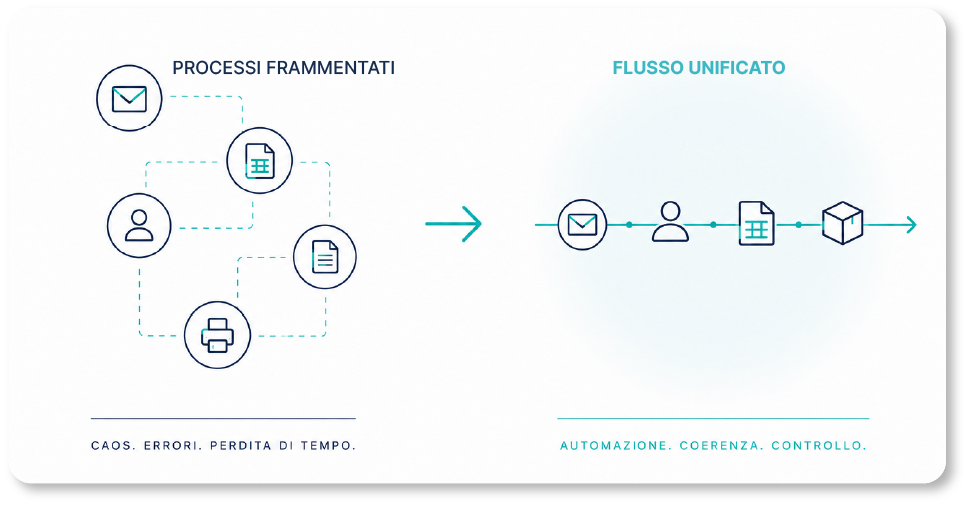
If you've never had a chance to do this before, try drawing a simple diagram using a notebook and a pen, as shown in the example below:
-
“When an order comes in from Amazon, Marta, the secretary, receives an email notification and logs into Seller Central to fulfill the order.”
-
“Marta copies the buyer's information into an Excel file to notify the courier of the pickup and arrange for shipment.”
-
“The same file is then emailed to the warehouse clerk—Luca—who prints it out to prepare the orders.”
-
...
A professionally conducted analysis—furthermore—must necessarily delve into a high level of technical detail so that, beyond the processes themselves, the various systems can communicate using a common language.
What often happens, for example, is that the product coding system adopted by the seller differs across various sales platforms: this initial situation makes the project more complex and should be identified during the analysis phase.
Types of Data Exchange
There is a form of standardization in data exchange between systems thanks to the widespread use of sets of procedures known as APIs (Application Programming Interfaces).
The fact that many software companies make their APIs available to third-party developers means they are open to “communicating” with the whole world.
A metaphor to explain what APIs are—if you don’t have technical expertise—is that of a house and a refrigerator. Imagine that the house is the software, such as Amazon’s Seller Central. You want to grab a bottle of water from the fridge, but Amazon doesn’t want to give you the keys to the house, because that would effectively hand over ownership to you. With APIs, it can do just that: it makes the house available to you but restricts your access to a specific use (getting a bottle of water from the fridge) without necessarily handing you the keys.
The widespread adoption of APIs represents a Copernican revolution for the entire world of software development and has made possible what would have been impractical before their advent. Data exchange via APIs occurs using XML or JSON files, but these are technical details we won’t delve into here.
Integrations based on data exchange in this manner generally limit performance (for example, updating available inventory quantities only once a day), but they are certainly simpler and faster to implement.
Mistakes to Avoid
Missteps: In our experience, it makes sense to approach an integration project with the proper caution.
From a conceptual standpoint, integration is a very simple process that involves exchanging data between software applications. From a functional perspective, however, every integration presents pitfalls that those with experience and familiarity are well aware of.
In the document—which you can download for free by filling out the form—you’ll find valuable information that can help you spend your time more effectively and in a goal-oriented manner.avoid
Start the certification process now
The skills required in the marketplace and e-commerce sectors are closely related to integration architecture.
The certification program, which remains free, begins with signing up for the MarketRock Academy, which you can do at any time. We will verify that your technical skills are appropriate for the required role and, if necessary, assign a mentor to provide you with the right support.
If you work for a company that wishes to use our services, you’ll have the opportunity to earn certification through the program we’ll undertake together. However, registering for the MarketRock Academy is the first mandatory step you must take.

Solution Provider Certifications
The Solution Provider certification is intended for agencies and software companies that have a development team dedicated to providing integrations and technical solutions to MarketRock customers.
Vai al progetto Postman
View the Postman project collection and read the documentation on our APIs to get a general idea of how they work and details on individual calls.